Helping Tweens & Teens Build Independence
by Kyle Kick
BStrong Together Executive Director
Building toward independence and autonomy is one of the goals of human development. It is a gradual, lifelong process that begins early in childhood and continues well into adulthood.
Independence is shaped by a combination of biological, psychological and social factors including:
- early foundations of trust and attachment with parents and caregivers,
- opportunities for exploration and decision-making,
- learning how to self-regulate,
- the development of problem-solving and critical thinking skills,
- the formation of identity and values,
- and learning to take responsibility for oneself.
As children grow, parents, caregivers and other trusted adults can assist in the creation of independence and autonomy through a process called “scaffolding.” Just as scaffolding is important to the creation of a building or structure, it provides an equally important foundation as our children grow.
As a parenting strategy, scaffolding happens when adults provide just enough temporary, targeted support to help their children to develop new skills, solve problems, tackle challenging tasks and develop independence. By gradually stepping back and reducing involvement and support as children’s skills grow, they gain competence and confidence – important building blocks of independence and autonomy.
At its core, scaffolding is about guiding, not doing. It requires attunement with your child to be able to identify areas where support is needed and adjust the level of assistance based on their abilities. It fosters self-discipline, reduces anxiety, improves well-being, builds resilience and helps to build strong relationships between parents and their children.
TIPS FOR HELPING YOUR TWEEN OR TEEN BUILD INDEPENDENCE
ASSESS THEIR NEEDS
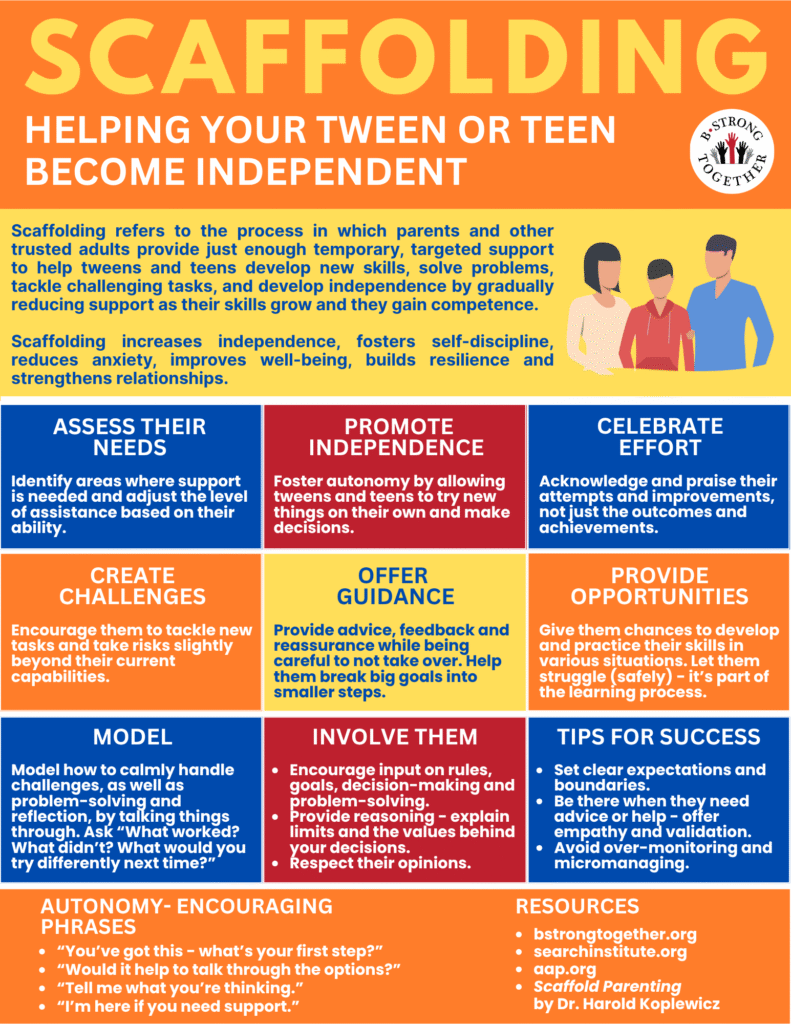
Scaffolding focuses on providing support within what scientists call a tween or teen’s “zone of proximal development” – tasks they can almost, but not quite, do on their own. Look for these areas of growth and identify what support is needed, adjusting the levels of assistance based on their ability.
PROVIDE OPPORTUNITIES
Give them chances to develop and practice their skills in various situations, encouraging them to tackle new tasks and take risks slightly beyond their current capabilities. Offer choices and let them make decisions. Listen to their concerns and perspective and ask guiding questions instead of giving answers. This will help them to build confidence in their own abilities.
BUILD RESILIENCE
Let them struggle (safely) – it’s part of the learning process. Offer empathy and validation, and be available for guidance when they struggle. Help them to learn from failures and bounce back from setbacks.
INVOLVE THEM
Encourage input on rules, goals, decision-making and problem-solving. Provide reasoning and explain limits and the values behind your decisions. Respect their opinions.
PROMOTE INDEPENDENCE
Foster autonomy and encourage self-advocacy by allowing them to try new things on their own and make decisions. Adolescence is a time for tweens and teens to explore who they are, what they believe and how they want to live. Empower them to communicate their needs and to stand up for themselves. Look for opportunities to gradually reduce your support as your teen gains competence and confidence. Autonomy grows when adults respect teens’ developing identities while providing guidance and boundaries.
CELEBRATE EFFORT
Acknowledge and praise their attempts and improvements, not just the outcomes and achievements. Focus your praise on repeatable behaviors and examples of their character.
OFFER GUIDANCE
Emotional safety creates a foundation for trying new things and making independent choices. Provide advice, feedback and reassurance while being careful to not take over. Help them break big goals into smaller steps. Offer empathy and validation and be available for guidance.
MODEL
Model self-regulation as well as problem-solving and reflection. Show them how to calmy handle challenges by talking things through. Ask “What worked? What didn’t? What would you try differently next time?”
TIPS FOR SUCCESS
- Set clear expectations and boundaries including routines and rules.
- Be there when they need advice or help – offer empathy and validation.
- Avoid over-monitoring and micromanaging.
- Stay curious and welcome discussion.
- Ask open-ended questions.
- Learn to recognize when to lean in and when to step back.
AUTONOMY- ENCOURAGING PHRASES
- “You’ve got this – what’s your first step?”
- “Would it help to talk through the options?”
- “Tell me what you’re thinking.”
- “I’m here if you need support.”
Scaffolding is a process based in trust and respect as you seek to both protect your child from harm while preparing them for greater independence and autonomy over their own lives.
~ Click on image below to download and print. ~